
Ringmore, St Nicholas
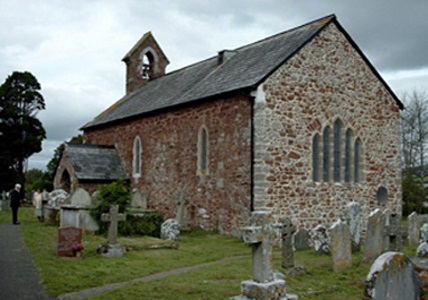
St Nicholas' Church is open every day of the year from 10.00 am to 4.00 pm
Regular Services at St Nicholas'
Services may occasionally be changed at short notice; please see the latest Newsletter for confirmation of service times.
- Sundays at 9.30am - Matins (Holy Communion on third Sunday, Prayer Service on fifth Sunday)
Finding Us
Find us with Google Maps (opens in new window)
Address: Ringmore Rd, Shaldon, Teignmouth TQ14 0ET
What Three Words: ///conforms.stopwatch.pricier
OS Map Reference: SX924723
Click here for directions to St Nicholas' (opens in new window)
Who's who in the Shaldon parish
Click here to see a list of church officers in Shaldon parish
Governance & Accountability
This is where Shaldon Parish publishes it's official information
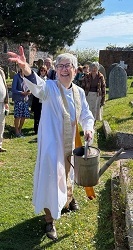
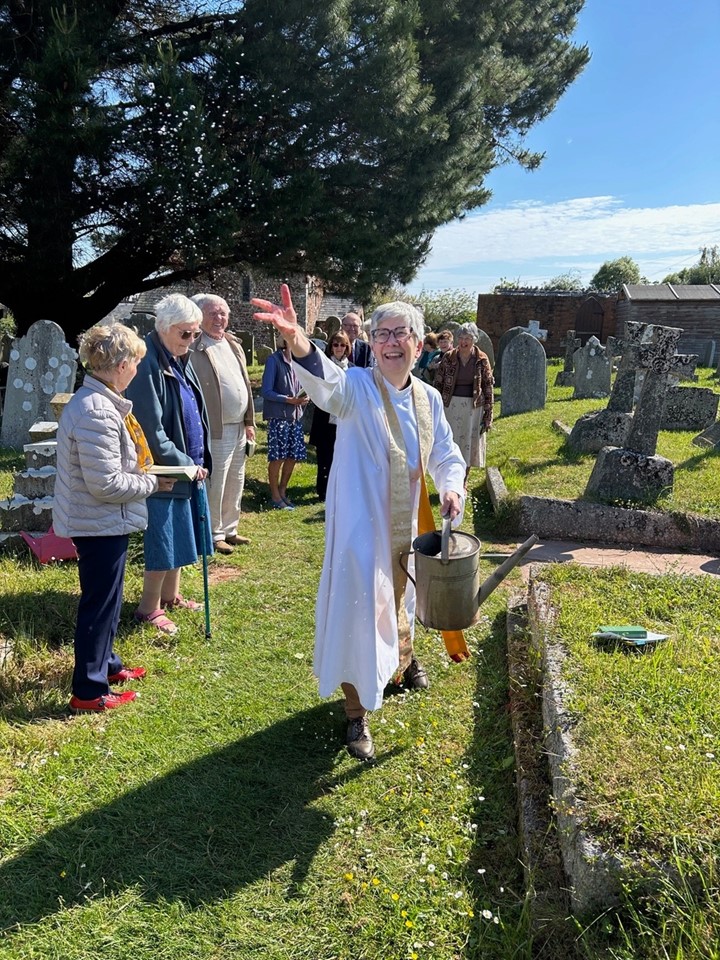
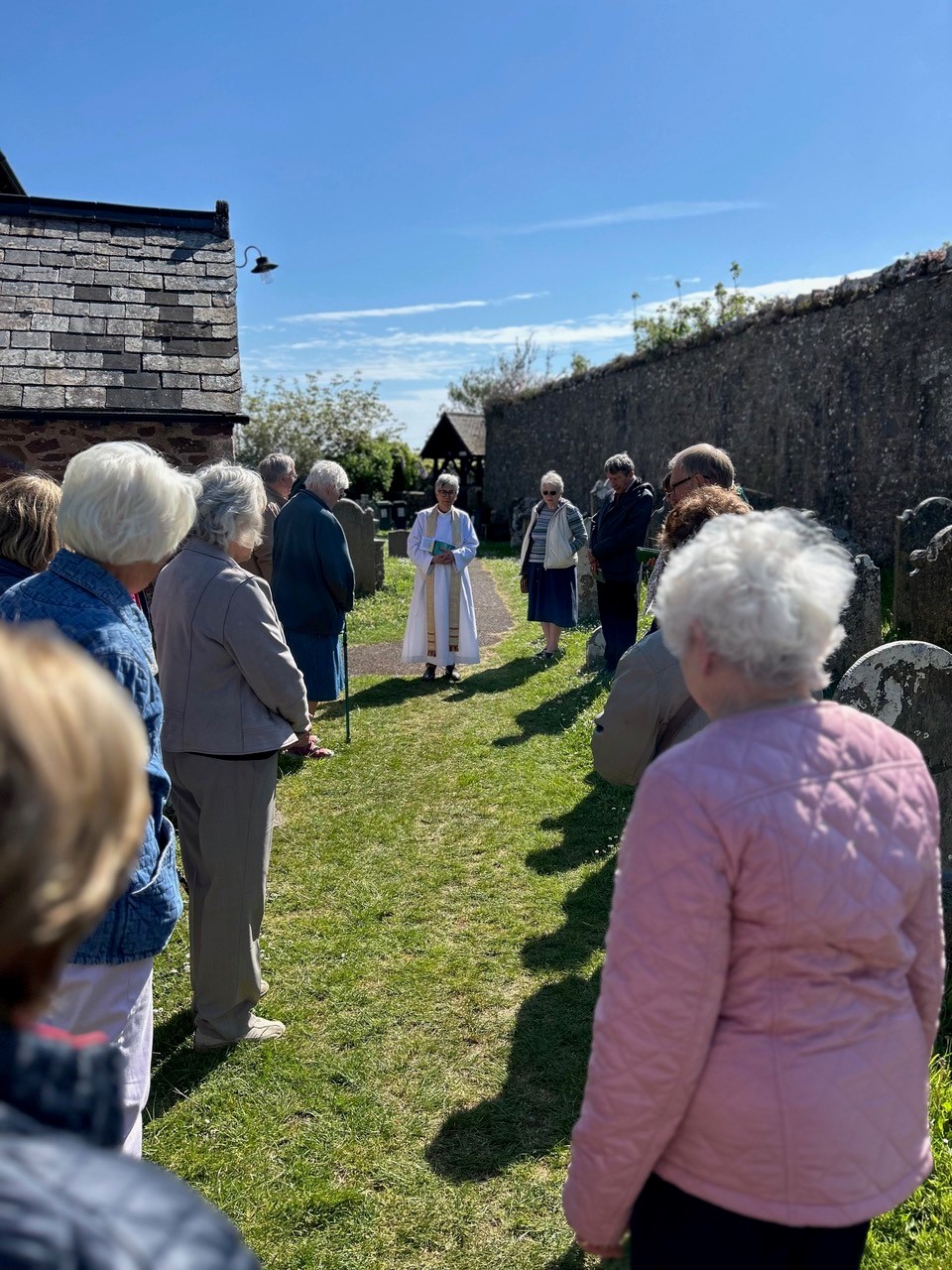
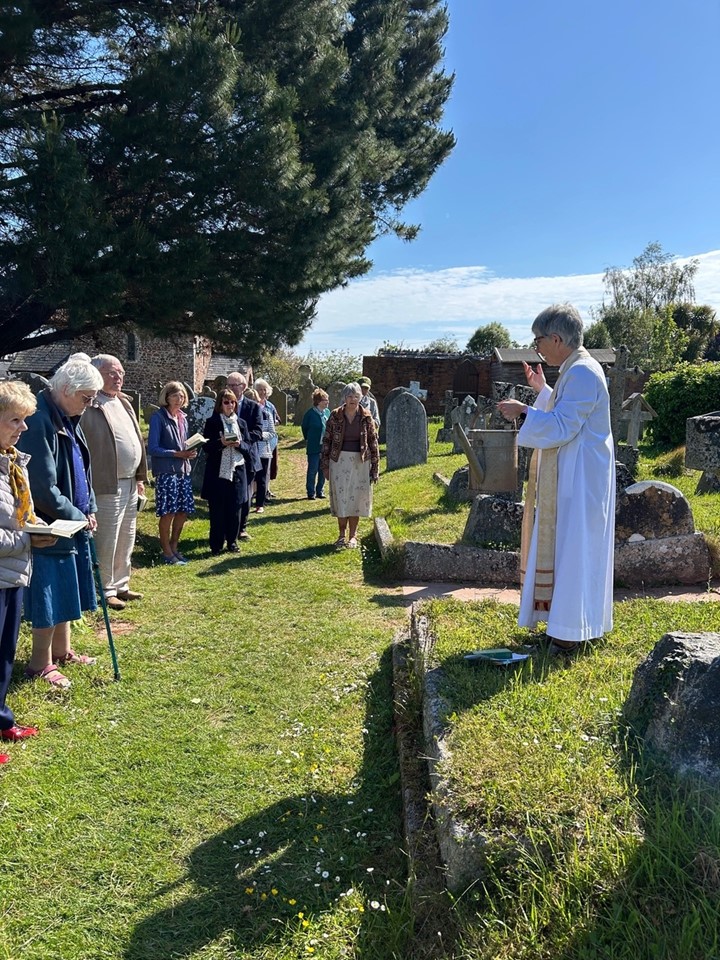
Last Sunday was Rogation Sunday, an ancient church festival which seeks blessing for a community and its sustenance. The word rogation comes from the Latin verb rogare, meaning "to ask", which reflects asking God for his protection. As the Book of Common Prayer puts it: “Rogation Days are the three days preceding Ascension Day, especially devoted to asking for God’s blessing on agriculture and industry.”
During the Eucharist on Rogation Sunday celebrated at Ringmore Church, the congregation were invited to walk and pray as they ambled around the churchyard. It gave an opportunity to view what the churchyard group had achieved, but also to pray for this sacred space - for those who visit, those who work here and those who have been laid to rest in this tranquil spot. On our walk we prayed for those who work on the land and for the wider community of Shaldon & Ringmore. The congregation were blessed with Holy Water using a galvanised watering can!
- Details
Access
There is level access into St Nicholas' churchyard via the Lych Gate.
Inside the church
The nave of the church itself is flat and very spacious with completely moveable furniture so wheelchair access is very easy . The Lady Chapel has one step up into it and The Chancel steep steps leading to a stepped High Altar.
Facilities
- Accessible toilets
A wheelchair is available on request (Please contact churchwarden to arrange).
Although parking is limited at the church itself Disabled Parking here can always be arranged with prior warning (Please contact churchwarden to arrange).
A Preview ...
Images to follow
- Details
St Nicholas Church, Ringmore now has its own licence for weddings so couples no longer have to apply to the Archbishop of Canterbury for a special licence! Couples will still have to meet the ‘qualifying connection’ criteria laid down by the Church of England but it should make the process much simpler and it gives our Benefice and Mission Community another beautiful wedding venue!
Please do spread the news!!
- Details
Sat-nav users:
Our postcode is TQ14 0ET
From the M5, heading south-west:
Continue on the M5 until it splits into the A30 and the A38. As the motorway ends, take one of the two right lanes, onto the A38.
Continue for about five miles to the point where the road splits into the A38 and A380. Take one of the left lanes for the A380, and climb Telegraph Hill. Continue on the A380 for about three miles, until you see the signs for the B3192 to Teignmouth.
Take the B3192, heading South East, follow this road until you come into Teignmouth (approximately five miles). At the first set of traffic lights, at the bottom of a long steep hill called 'Exeter Road' move into the right-turn lane and turn onto the A379. Follow this road for a little under half a mile until you reach a set of traffic lights, take the left turn slip lane to take you onto the bridge (also the A379). Continue down the slope, over the railway and across Shaldon Bridge. At the end of the bridge on your left is St. Peter's Church.
Once alongside St. Peter's continue straight on until the road turns sharp right (300 yards), follow the road around and then turn right into Ringmore road.
After a little over half a mile along the south side of the estuary you will see a side turn called 'The Strand' on your right (you are unlikely to be able to park a car closer than here beside the estuary). From here the pathway down to St. Nicholas is approximately 100 yards in front of you on the right as the road swings to the left (see map). Once on the pathway the Lych gate entrance to St. Nicholas is visible straight in front of you.
From Torquay, heading north-east:
Follow road signs for Teignmouth on the A379 Teignmouth road through Maidencombe, around Labrador bends and down the long hill into Shaldon village. At the lower end of the hill is a sweeping right hand bend, followed by a short straight with a very sharp left hand junction into Ringmore road. This turn almost doubles back on the direction that you have come.
After a little over half a mile along the south side of the estuary you will see a side turn called 'The Strand' on your right (you are unlikely to be able to park a car closer than here beside the estuary). From here the pathway down to St. Nicholas is approximately 100 yards in front of you on the right as the road swings to the left (see map). Once on the pathway the Lych gate entrance to St. Nicholas is visible straight in front of you.
- Details
| Our first picture shows the Lych gate access to the Church of St. Nicholas viewed from the pathway leading from the road. | 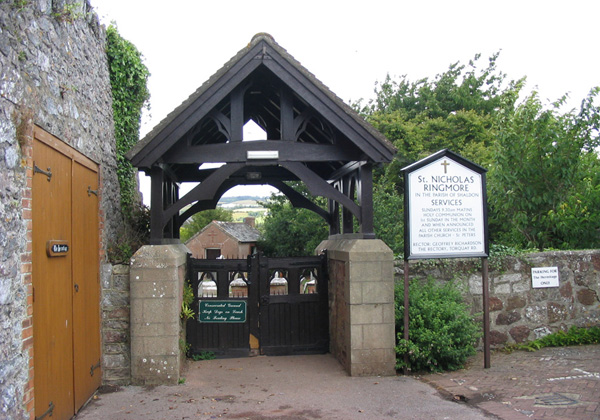 |
| This picture shows the Church as viewed from just inside the Lych gate. | 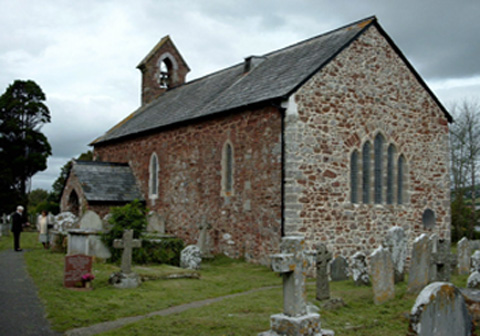 |
| This photograph of the western end of the Church shows the view from the older part of the graveyard | 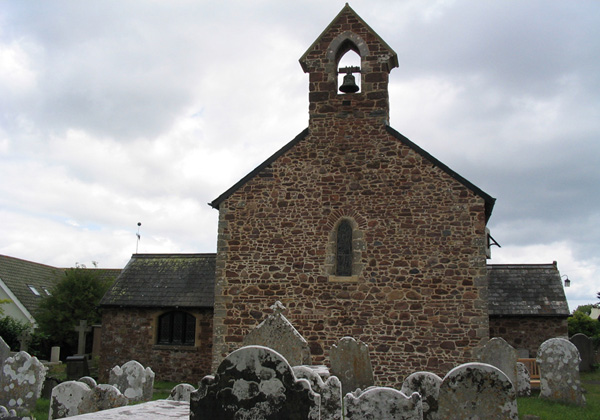 |
| A view towards the Sanctuary from in front of the Font. | 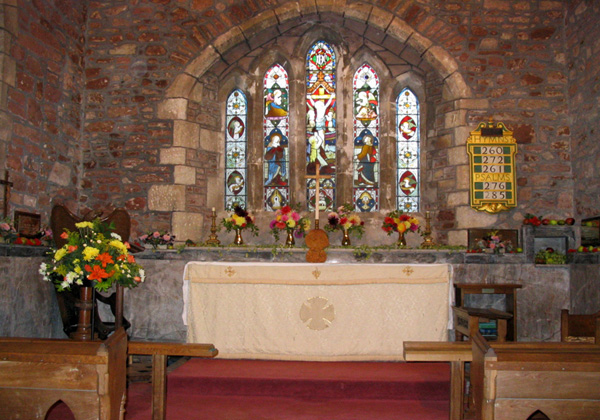 |
| And here is the Font, believed to be late Saxon or early Norman. It replaced the original probably at some time in the early eighteen hundreds. | 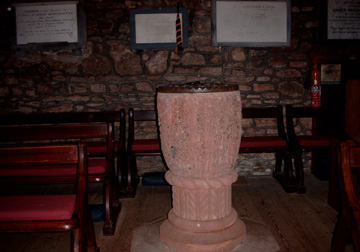 |
- Details
|
In Domesday Book it is recorded that “Ronmore” (as Ringmore was then known) was one of the Devon Manors. Another was Haccombe some four miles west of Ronmore . In 1233 Stephen de Haccombe, the Lord of the Manor of Haccombe, returned from a Crusade and as a thanksgiving offering built a Chapel close to his Manor house. This was intended to be a Chantry Chapel in which prayers might be said for Stephen and his family and all necessary ecclesiastical functions performed. He installed a Priest at his own expense, but did not consult the Bishop. 
Later, about 1280 according to reliable evidence, Stephen and his successors built two more Chapels, St. Michael at Combehall near Drewsteignton, and St. Nicholas at “Ronmore”.Only small fragments of a ruin now exist at St. Michael’s. Church architects are agreed St. Nicholas is of 13th Century origin. The whole of the east end, with its lancet windows, is accepted as such, and this is further borne out in a proclamation by Sir John Lerchedeckne (the third successor of Stephen) in 1384. In 1445 John Carnell, Archpriest, of Haccombe, died and left in his will “a light to be placed before the image of St. Nicholas in Ringmore”. The Register of Baptisms recorded at St. Nicholas starts in 1616 but a note states that prior to 1621 baptisms had been performed at Haccombe. It may be assumed that marriage and burial ceremonies were also performed at Haccombe before 1621. About this time the Carews, now Lords of the Manor of Haccombe, carried out extensive repairs to the fabric of St. Nicholas. Fortunately the stone, size and architectural features were retained. Until this time clergy from Haccombe and other Churches officiated at St. Nicholas but in 1621 the Baptism Register is signed by Elezeus Coke, “First Professor of Christ’s Gospel in this Church…”. Burial Registers were started at St. Nicholas in 1622 and in 1628 Marriage Registers were started. In 1671 Lord Clifford bought several estates in this area, including the Manor of Ringmore with St Nicholas Parish. Bishop Keppel’s second Visitation in 1768 states there was serious deterioration in the administration at St. Nicholas. 
His report seems to have achieved results as, by 1790, a very big extension had been added. This involved removing a large portion of the north wall and building out some 32 feet towards the river. A gallery was built on the south wall, partly for the choir which entered it by an external staircase. Another gallery was built on the west wall for the congregation with access by a covered stairway. An organ was mentioned in 1827 but this was replaced by a “seraphine” in 1847 (precursor of the Harmonium). In 1839 a gallery was added to the north wall for the Sunday School. A new roof with a domed skylight and a square wooden bell tower was built in 1841. The original font had been disposed of and replaced by the present Saxon or early Norman one. About this time it was decided to create a more normal design of Parish Church. The original part was to be used as a kind of south aisle, but stripped of galleries, altar, pulpit, etc. Plans were submitted by the Vicar, the Reverend William Henry Wrenford, but he died before the work could be started. The next Vicar, the Reverend Richard Marsh-Dunn, cancelled these plans, having decided to build a new Church nearer to the greater population of Shaldon. This was consecrated and dedicated to St. Peter in 1902 and became the new Parish Church of St. Nicholas, South Devon in 1903. St. Nicholas Church was renovated at the expense of a generous benefactor and was officially designated as a Chapel of Ease. This is the present state. |
- Details